Quick answer
New Jersey’s Private Well Testing Act (PWTA) requires well water testing when a property with its own private drinking water well is sold. For covered rentals, landlords must test at least every five years and provide the results to tenants. An NJDEP-certified lab must test untreated well water. Arrange the sample collection through that lab. The law is about disclosure. It does not block a sale if the water fails, and it does not require anyone to install treatment, though a lender or local health department sometimes does.
This is general information, not legal advice. Rules change, so confirm the details with NJDEP, your attorney or your lab.
When a PWTA test is required
The PWTA was signed in March 2001, and its rules took effect in September 2002 (NJDEP). It applies to (NJDEP):
- The sale of a property that gets its drinking water from a private well on the property, including new construction.
- The sale of a property served by a small well with fewer than 15 service connections, or one that doesn’t regularly serve an average of at least 25 people daily for at least 60 days a year.
- Leasing a property with a private drinking-water well if testing is not required by another state law. Test at least every five years.
A well used only for things like lawn watering, and not for drinking water, doesn’t have to be tested under the Act (NJDEP).
Sellers and buyers
Every contract of sale for a covered property must include a provision requiring the test. Closing can’t happen until both buyer and seller have received and reviewed the results and signed a certification saying so (N.J.S.A. 58:12A-27; NJDEP). Who pays is negotiated between buyer and seller (NJDEP).
NJDEP publishes a testing-cost estimate, but lab rates vary. Ask the lab for a quote, including any charge to analyze the field blank (NJDEP).
Landlords and tenants
For a leased property, the landlord must arrange and pay for the test (NJDEP). The statute requires the landlord of a covered property to test at least once every five years, and to give a copy of the results to each rental unit within 30 days of receiving them and to each new tenant. For seasonal rentals, post the results in a readily visible place inside the rental unit or give the new tenant a written copy of the latest results (P.L.2003, c.236). NJDEP warns that skipping a required test can lead to enforcement action (NJDEP).
What is tested
The required list is set by N.J.A.C. 7:9E-2.1 (N.J.A.C. 7:9E; NJDEP):
| Group | Parameters |
|---|---|
| Bacteria | Total coliform; E. coli only if coliform is positive |
| Basic chemistry | Nitrate, pH, iron, manganese |
| Metals | Lead and arsenic |
| Radioactivity | Gross alpha particle activity |
| PFAS | PFOA, PFOS and PFNA in the published state rule. See the sale-testing guidance below for three additional PFAS. |
| Volatile organic compounds | 26 listed VOCs, such as benzene, MTBE and trichloroethylene |
| Synthetic organic compounds | 1,2,3-trichloropropane (1,2,3-TCP), ethylene dibromide (EDB) and DBCP |
County-specific tests
- Uranium is required in Bergen, Essex, Hudson, Hunterdon, Mercer, Middlesex, Morris, Passaic, Somerset, Sussex, Union and Warren counties.
- Mercury is required in Atlantic, Burlington, Camden, Cape May, Cumberland, Gloucester, Monmouth, Ocean and Salem counties.
Both county lists come from NJDEP and the rule. Local requirements also apply; where they overlap, the more stringent one is followed, so check with your local health authority (NJDEP).
Recent additions and PFAS
The three synthetic organic compounds, including 1,2,3-TCP, were added as of March 3, 2019. PFOA, PFOS and PFNA have been required since December 1, 2021 (N.J.A.C. 7:9E-2.1).
The published rule lists PFOA, PFOS and PFNA (N.J.A.C. 7:9E; NJDEP PFAS actions). For a real estate sale, NJDEP’s PFAS FAQ also directs labs to analyze GenX (HFPO-DA), PFBS and PFHxS (NJDEP PFAS FAQ). The state form lists those three separately (NJDEP reporting form), and NJDEP’s PFAS strategy says the rules will be amended (NJDEP PFAS strategy). Ask your NJDEP-certified lab to confirm the current list before ordering a sale or rental test.
Who collects the sample, and how
An NJDEP-certified lab or its authorized representative must collect the samples. The person who collects and analyzes the sample for pH must be an employee of a lab certified for pH (N.J.A.C. 7:9E-2.2).
The lab collects untreated well water from a primary cold, non-aerated tap or other approved sample point. If treatment equipment is installed, the sampler takes the sample before treatment or follows the rule for disabling the treatment. The sampler handles flushing before collection (N.J.A.C. 7:9E-2.3; NJDEP). The result describes raw well water, not filtered water.
Lead is tested on this flushed raw sample and compared to a 5 µg/L standard. The 15 µg/L lead action level applies to a different sample, a first-draw tap sample, which the PWTA does not require (NJDEP reporting form).
Prestige Water Group is not a certified lab and does not collect PWTA samples. Hire an NJDEP-certified lab for that part.
How long results are valid
For a sale, most PWTA results are valid for one year from collection. Coliform results are valid for six months. If the other results are still valid, ask your lab to repeat the coliform test (N.J.A.C. 7:9E-3.3; NJDEP). Results are no longer valid if a new water source is installed (N.J.A.C. 7:9E-3.3).
If the water fails
The law does not prohibit the sale, and it does not require treatment. Whether to install treatment, and who pays for it, is for the buyer and seller to negotiate. In some cases mortgage companies or local health departments may require treatment (NJDEP).
The lab reports the results to the requester and NJDEP (P.L.2001, c.40). If a coliform or nitrate result exceeds the applicable limit, the lab must notify the requester and local health authority within 24 hours of obtaining the result (N.J.A.C. 7:9E-4.1). NJDEP also notifies local health authorities of failed results. NJDEP and local health authorities keep the well address confidential (P.L.2001, c.40).
Two state programs may help eligible owners: the Spill Compensation Fund, which covers human-caused discharges of hazardous substances, and the NJHMFA Potable Water Loan Program (NJDEP). Eligibility rules are strict, so contact those agencies directly.
Where water treatment comes in
Iron, manganese and pH are “secondary” parameters. They mostly affect taste, staining and corrosion (N.J.A.C. 7:9E). Results above primary standards such as arsenic, nitrate, bacteria, PFAS or gross alpha are health-based (NJDEP reporting form), and NJDEP says that water should be treated or not consumed (NJDEP). For arsenic above 5 µg/L, NJDEP recommends a whole-house system (NJDEP).
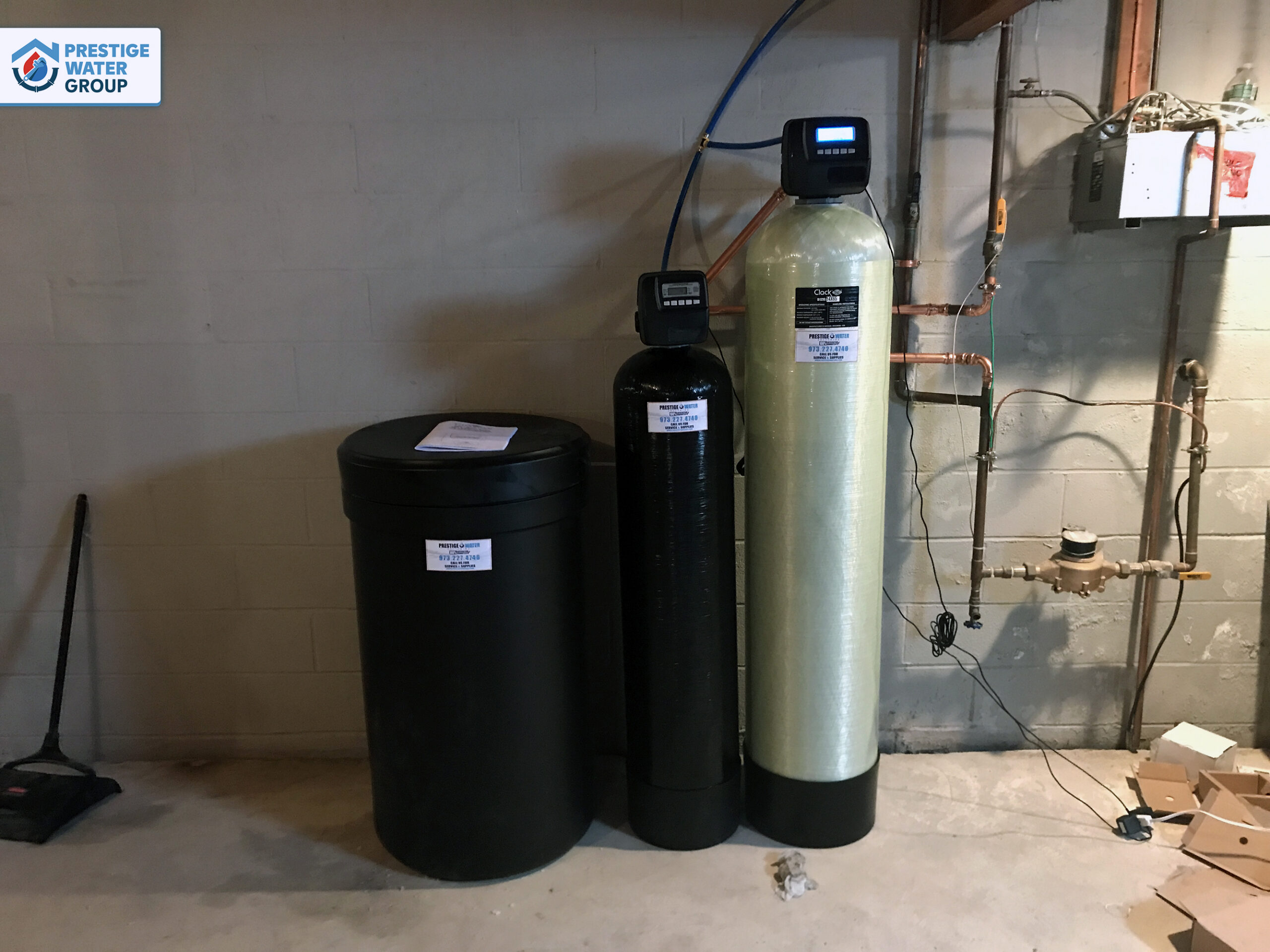
NJDEP recommends hiring a water treatment professional to design and install treatment (NJDEP reporting form). After an NJDEP-certified lab collects and tests the sample, we can review the report and discuss PFAS treatment, whole-house filtration, a softener or reverse osmosis, as appropriate. After installation, retest periodically to confirm the system is working (NJDEP).
When to call a professional
- Ordering the test or sampling: an NJDEP-certified lab.
- Contract or lease questions: your attorney or agent.
- Questions about a failed result or whether the water is safe to use: ask your lab or local health department.
- For treatment equipment or well pressure tank work, call us.
We serve well owners across North Jersey, including Morris, Sussex and Bergen counties. We do not service well pumps or drill wells.
Frequently asked questions
Can I sell my house if the well water fails?
Yes. The PWTA does not prohibit the sale. Treatment is negotiated between buyer and seller, unless a lender or local health department requires it (NJDEP).
Can the sample be taken after my filter?
Not if the water has passed through active treatment. The lab will choose a sampling point or arrange to bypass the treatment (N.J.A.C. 7:9E-2.3).
How often do landlords have to test?
For a covered rental, test at least every five years. Give each unit the results within 30 days of receiving them and give new tenants the latest results. Seasonal rentals may use the posting option above (P.L.2003, c.236).
Is uranium tested everywhere?
No. It’s required only in 12 counties, including Morris, Bergen, Passaic and Sussex (NJDEP).
Help after your well test
Once you have your lab report, call Prestige Water Group at (973) 227-4740. We’ll go through it with you and recommend treatment only for what the test found. We’re open Monday through Saturday, 9 AM to 5 PM, with emergency plumbing service 24/7. You can also request service online.
Sources
- NJDEP, New Jersey Private Well Testing Act: https://dep.nj.gov/privatewells/pwta/
- N.J.A.C. 7:9E, Private Well Testing Act rules (NJDEP courtesy copy): https://dep.nj.gov/wp-content/uploads/rules/rules/njac7_9e.pdf
- N.J.S.A. 58:12A-27 (sale provisions): https://law.justia.com/codes/new-jersey/title-58/section-58-12a-27/
- N.J.S.A. 58:12A-32 (lease provisions), P.L.2003, c.236: https://pub.njleg.gov/bills/2002/PL03/236_.HTM
- Private Well Testing Act, P.L.2001, c.40: https://pub.njleg.gov/bills/2000/PL01/40_.HTM
- NJDEP, State PFAS actions: https://dep.nj.gov/pfas/action/
- NJDEP, Private Well Test Reporting Form (rev. May 19, 2025): https://dep.nj.gov/wp-content/uploads/privatewells/pwta-reporting-form-pfas.pdf
- NJDEP, FAQ on PFAS in Drinking Water: https://dep.nj.gov/wp-content/uploads/pfas/docs/faq-pfas-in-drinking-water.pdf
- NJDEP, Private Well Testing: https://dep.nj.gov/privatewells/testing/
- NJDEP, Arsenic: https://dep.nj.gov/privatewells/arsenic/
- NJDEP, Well Water Treatment: https://dep.nj.gov/privatewells/treatment/
- NJDEP, PFAS Strategy (2025): https://dep.nj.gov/wp-content/uploads/pfas/docs/njdep-pfas-strategy-2025.pdf
Need water treatment in Northern New Jersey?
Prestige Water Group serves homes and businesses from Hawthorne, NJ. Call (973) 227-4740 or request an appointment online.