Quick answer
A metallic taste in tap water usually comes from iron, manganese, copper or zinc, or from acidic (low-pH) water that is dissolving metal from your pipes. At typical nuisance levels these are mostly taste and staining problems, though high copper can upset your stomach and the bigger hidden risk is lead: you can’t taste it, and the same corrosive water that dissolves copper can dissolve lead. Stain colors give good clues, but only a lab test tells you what’s actually in your water and what treatment, if any, makes sense.
What a metallic taste usually means
The EPA lists several substances whose main effects are on taste, color and staining, not health, at their recommended limits (EPA secondary standards). The usual suspects behind a metallic taste are:
| Likely cause | Other clues | EPA recommended limit |
|---|---|---|
| Iron | Rusty color, sediment, reddish or orange stains | 0.3 mg/L |
| Manganese | Black to brown color, black stains, bitter taste | 0.05 mg/L |
| Copper | Blue-green stains in sinks and tubs | 1.0 mg/L |
| Low pH (acidic water) | Bitter metallic taste, corrosion of pipes and fixtures | pH 6.5–8.5 |
| Zinc | Metallic taste | 5 mg/L |
All limits above are from the EPA. Zinc is less common. Galvanized pipe is steel coated with zinc, so older galvanized plumbing is one possible source.
Iron and manganese
These are the usual cause in private wells. The water can come out of the tap clear and then form orange-brown (iron) or black (manganese) particles or stains once it’s exposed to air (Penn State Extension). NJDEP calls iron and manganese nuisance contaminants that are generally not a health concern (NJDEP). For manganese, the EPA has set a non-enforceable lifetime health advisory of 0.3 mg/L because of possible neurological effects, and advises not exceeding 0.3 mg/L even over a short 10-day period for infants under 6 months, such as in water used to mix formula (EPA; Penn State Extension).
Copper and low pH
Water that is soft and acidic tends to be corrosive (Penn State Extension). It can dissolve copper from pipes, which leaves blue-green stains and a metallic taste. The taste is usually worst in the first water out of the tap after it sat overnight (Penn State Extension). In some cases the corrosion is bad enough to cause leaks (Penn State Extension). Copper has an EPA health goal and action level of 1.3 mg/L. High copper exposure can cause stomach or intestinal distress in the short term and liver or kidney damage over time, and people with Wilson’s disease should check with their doctor if copper is above the action level (EPA).
The serious case: lead
You cannot see, taste or smell lead in water. Testing is the only sure way to know (EPA). The EPA’s health goal for lead is zero. Even low levels in children’s blood can cause behavior and learning problems, lower IQ and slowed growth; in pregnancy lead can reach the fetus; and in adults it can raise blood pressure and reduce kidney function (EPA). The current federal lead action level for public water systems is 15 ppb (EPA). Under EPA’s Lead and Copper Rule Improvements, the compliance date for the lower 10 ppb action level is November 1, 2027 (Federal Register; EPA; EPA timeline). An action level is the point that requires a water system to take action, not a safe level for your home. The most common sources are lead service lines, lead pipes, brass faucets and lead solder, and lead pipes are more likely in homes built before 1986 (EPA). A metallic taste doesn’t mean you have lead. But if corrosive water is attacking your copper pipes, it can also dissolve lead from solder (Penn State Extension), so test for lead too.
In New Jersey, galvanized service lines are treated as lead service lines (NJDEP). New Jersey generally requires public community water systems to replace known lead service lines by July 22, 2031, though extensions are possible (NJDEP; P.L.2021, c.183). Ask your water system about its schedule and any costs before hiring anyone (NJDEP).
While you wait for results, the EPA recommends that you (EPA):
- Use only cold water for drinking, cooking and baby formula. Boiling does not remove lead.
- Run the water before drinking if it has been sitting in the pipes. Ask your water utility how long to flush your tap before drinking, and follow any local advisory.
- Use a filter certified to remove lead, and replace the cartridge on schedule.
- Clean your faucet aerator regularly. Here’s how to clean a faucet aerator.
Showering and bathing are considered safe, because skin does not absorb lead from water (EPA).
What you can check yourself
- Do not taste the water to check for metals. Note when you first noticed the change and whether it affects one faucet or several. Ask a certified lab how to collect a sample for lead and copper.
- Check stain colors: orange-brown points to iron, black to manganese, blue-green to copper.
- Note whether your exposed pipes are copper, galvanized steel or plastic. That helps narrow down the source.
- On city water, read your utility’s notices and ask whether your service line is lead, galvanized or unknown.
- A home test kit can screen pH and iron, but use a certified lab for lead and copper.
Getting the right test
For lead or copper coming from household plumbing, the lab may ask for a first-draw sample (Penn State Extension). Official New Jersey Private Well Testing Act (PWTA) lead samples are collected after flushing (N.J.A.C. 7:9E). Ask an NJDEP-certified lab for the right instructions.
For private wells, the New Jersey Department of Health recommends testing pH every year, and lead, iron and manganese every five years, as summarized by NJDEP. NJDEP also lists a change in your water’s color, odor or taste as a reason to test (NJDEP). The PWTA requires testing for covered sales and rentals, including iron, manganese, pH and lead. Arrange official sample collection through an NJDEP-certified lab (NJDEP; N.J.A.C. 7:9E).
Treatment options
The fix depends on what the test shows. For corrosion, the fix is at the source:
- Low pH: An acid-neutralizing filter (for example, calcite) raises pH. It also adds hardness and needs regular refills. A soda ash or sodium hydroxide feed is the alternative and does not add hardness; soda ash is preferred because sodium hydroxide is extremely caustic (Penn State Extension). NJDEP lists an acid neutralizer as the treatment for pH (NJDEP).
- Iron and manganese: A water softener can handle low levels of clear, dissolved iron under the right conditions (generally pH above 6.7, hardness of 3 to 20 grains per gallon and iron under 5 mg/L), though solid oxidized iron or manganese will foul the resin. Higher levels call for an oxidizing filter or oxidation followed by filtration (Penn State Extension).
- Lead and copper at the tap: Penn State lists reverse osmosis, distillation and activated alumina as acceptable point-of-use options for drinking and cooking water, and does not recommend granular activated carbon for lead and copper (Penn State Extension). NJDEP lists reverse osmosis and faucet or pitcher filters certified to remove lead (NJDEP). Check that any unit you buy, including reverse osmosis, is certified for lead reduction.
- Old or failing pipes: Replacing corroded plumbing is sometimes the real fix (Penn State Extension). Read more about pipe replacement.
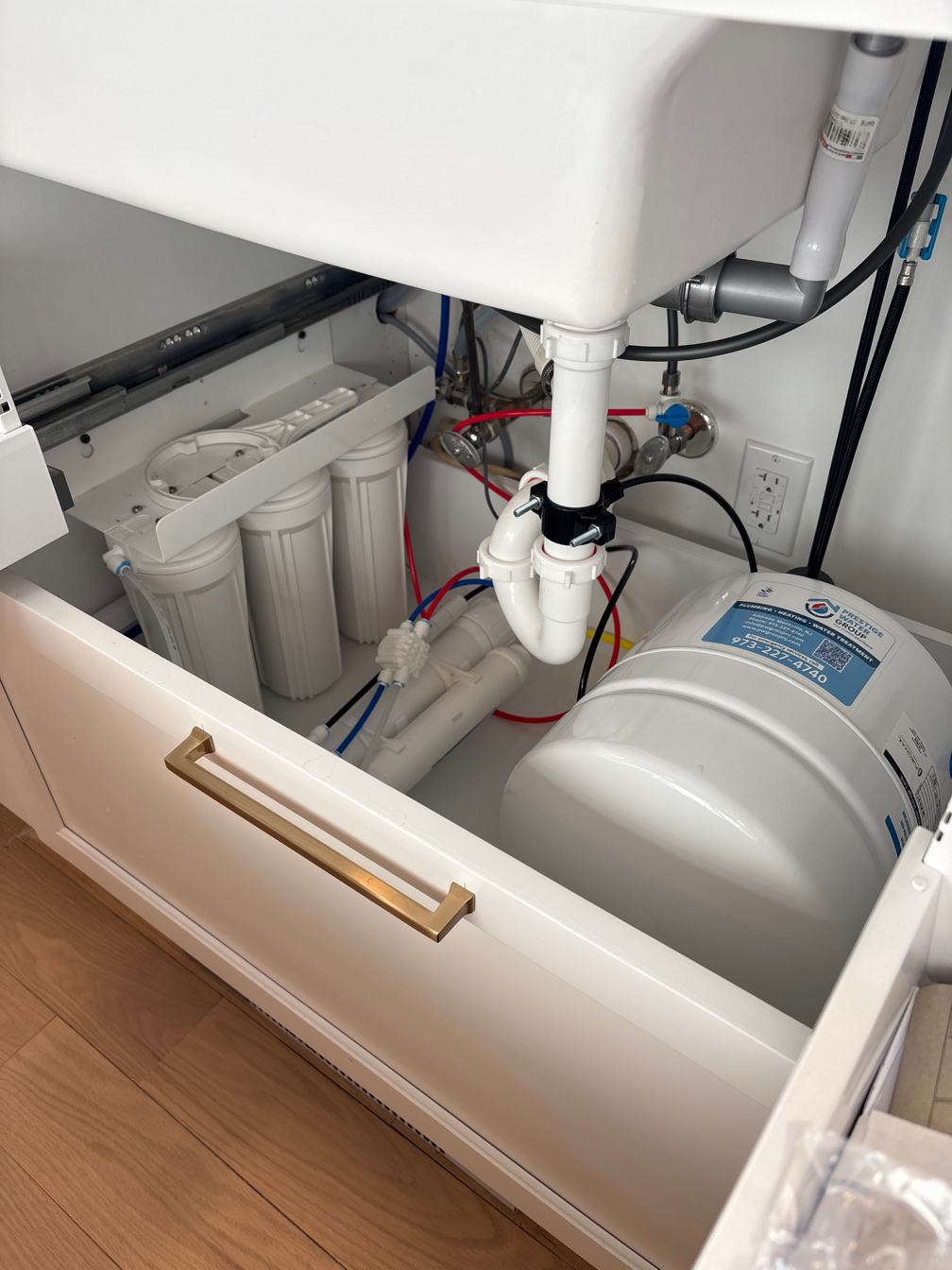
We install whole-house filtration, water softeners and reverse osmosis systems. We size them from your water test, not from the taste alone.
When to call a professional
- You see blue-green stains, pinhole leaks or green crust on copper fittings.
- A lab test shows low pH, high iron or manganese, or any lead.
- Your water system says your service line is lead, galvanized or unknown.
- You have a well and the taste changed suddenly.
- You want help reading a lab report before buying equipment.
Frequently asked questions
Is water that tastes like metal safe to drink?
Taste cannot tell you whether water is safe. Iron, manganese or copper can affect taste, and lead has no taste (EPA). Ask a certified lab about testing before deciding what treatment, if any, you need.
Why does my water taste metallic only in the morning?
Water that sits in copper plumbing overnight picks up more metal, especially if the water is corrosive (Penn State Extension).
What do blue-green stains mean?
Blue-green stains are a classic sign of copper from corrosive water (EPA). Test the pH, and test for copper and lead.
Will boiling the water get rid of the metal?
No. Boiling does not remove lead or other dissolved metals (EPA). Use cold water and a filter certified for whatever your test finds.
Will a water softener fix a metallic taste?
Only in some cases. A softener can remove low levels of dissolved iron under the right conditions (Penn State Extension), but it doesn’t correct low pH, and soft, acidic water tends to be the most corrosive (Penn State Extension).
Help after a water test
If your water tastes like metal, call Prestige Water Group at (973) 227-4740. We’ll review your lab results, look at your plumbing, and recommend treatment or pipe work only when the results call for it. We’re open Monday through Saturday, 9 AM to 5 PM, with emergency plumbing service 24/7. You can also request service online.
Sources
- U.S. EPA, Secondary Drinking Water Standards: https://www.epa.gov/sdwa/secondary-drinking-water-standards-guidance-nuisance-chemicals
- U.S. EPA, Basic Information about Lead in Drinking Water: https://www.epa.gov/ground-water-and-drinking-water/basic-information-about-lead-drinking-water
- Penn State Extension, Corrosive Water Problems: https://extension.psu.edu/corrosive-water-problems
- Penn State Extension, Iron and Manganese in Private Water Systems: https://extension.psu.edu/iron-and-manganese-in-private-water-systems
- NJDEP, Private Well Testing: https://dep.nj.gov/privatewells/testing/
- NJDEP, Well Water Treatment: https://dep.nj.gov/privatewells/treatment/
- NJDEP, New Jersey Private Well Testing Act (PWTA): https://dep.nj.gov/privatewells/pwta/
- New Jersey Administrative Code, N.J.A.C. 7:9E (Private Well Testing Act rules): https://dep.nj.gov/wp-content/uploads/rules/rules/njac7_9e.pdf
- New Jersey Legislature, P.L.2021, c.183 (lead service line replacement): https://pub.njleg.gov/Bills/2020/PL21/183_.HTM
- Federal Register, Lead and Copper Rule Improvements final rule: https://www.federalregister.gov/documents/2024/10/30/2024-23549/national-primary-drinking-water-regulations-lead-and-copper-rule-improvements
- NJDEP, For Residents Receiving Notice of a Lead or Unknown Service Line: https://dep.nj.gov/lead/notices/
- NJDEP, Lead Exposure Reduction, Additional Resources: https://dep.nj.gov/lead/resources/
- U.S. EPA, Drinking Water Health Advisory for Manganese (EPA-822-R-04-003): https://nepis.epa.gov/Exe/ZyPURL.cgi?Dockey=P100537R.TXT
- U.S. EPA, National Primary Drinking Water Regulations: https://www.epa.gov/ground-water-and-drinking-water/national-primary-drinking-water-regulations
- U.S. EPA, Lead and Copper Rule Improvements fact sheet: https://www.epa.gov/system/files/documents/2024-10/final_lcri_fact-sheet_general_public.pdf
- U.S. EPA, LCRI Timeline: https://www.epa.gov/system/files/documents/2026-09/lcri-timeline_glo-program_cdm-smith_1.pdf
Need a plumber in Northern New Jersey?
Prestige Water Group serves homes and businesses from Hawthorne, NJ. Call (973) 227-4740 or request an appointment online.